Release Forms and Clearances: A Producer's Checklist
By Elliot Shaw · Published · Updated · 5 min read
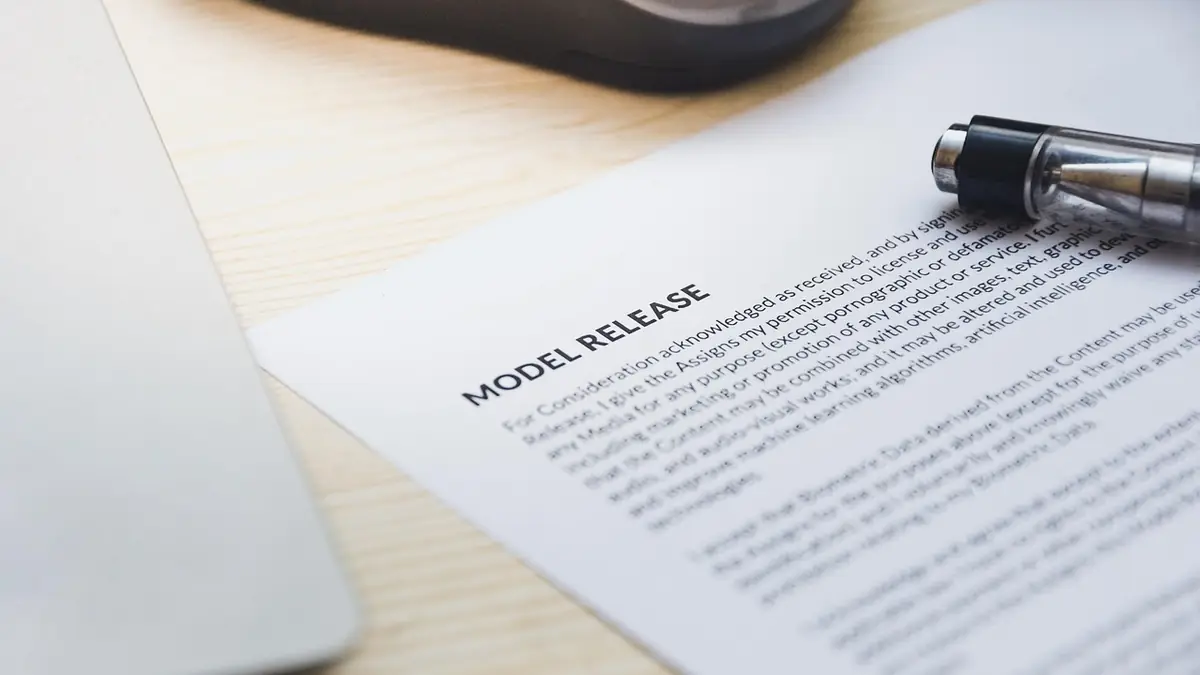
Every shoot generates paperwork, and the paperwork is what keeps a finished project usable. A talent release, a signed location agreement, and a documented music license are the three documents that most often decide whether a video can be broadcast, streamed, or reused years later.
This checklist is built for small crews and modest budgets, where a producer often handles contracts alongside scheduling. The goal is not legal perfection but practical coverage: know what to sign, when to sign it, what it typically costs, and where the gaps tend to appear.
Talent Releases: Get Signature Before the Camera Rolls
A talent release grants the production the right to use a person's image, voice, and name in the finished work. For non-union projects, a one-page release is usually enough, but it must cover the intended media (broadcast, web, social, internal), the territory, and the duration. Avoid open-ended 'perpetual, worldwide, all media' language on paid talent unless the fee reflects it; many agents will push back, and it signals inexperience.
Timing matters more than wording. Collect signatures during check-in, before makeup or setup, when the contributor is calm and the schedule has slack. Chasing a release by email two weeks after wrap is where most small productions lose time. Keep a printed folder and a digital scan; a phone photo of a signed page is acceptable evidence if the original is legible.
Minors require a parent or guardian signature, and some jurisdictions require the guardian to be present. Budget extra time for this. For documentary or unscripted work, a short appearance release with a clear description of the project is standard; for scripted work, add a clause confirming the contributor has no approval rights over the final cut.
- Sign at check-in, not after wrap
- Specify media, territory, and term
- Guardian signature for anyone under 18
- Keep both a paper original and a scan
Location Agreements: Protect Access and Avoid Surprises
A location release does two jobs: it confirms permission to film and it sets the terms for how the footage can be used. The property owner should sign before the crew arrives, and the document should name the production company, the dates, the areas covered, and any restrictions such as noise limits or parking. Verbal permission from a building manager is not enough when the footage later appears in a campaign.
Expect to negotiate small things: a certificate of insurance, a cleanup deposit, or a specific credit. For residential locations, a modest fee is common; for commercial spaces, owners often ask for a copy of the final video or a social media mention instead of cash. Clarify who pays for damage and whether the owner can revoke access mid-shoot.
One frequently missed point is the footprint. If the agreement covers only the living room but the crew films the garden, the release does not protect that footage. Attach a simple floor plan or photo set and have the owner initial it. This takes five minutes and prevents arguments later.
- Name the production entity, not the individual
- Attach photos or a plan of approved areas
- Agree on insurance and damage terms
- Confirm parking, power, and noise limits
Music Clearances: The Most Common Post-Production Trap
Music is where well-run productions most often stumble, because two separate rights are involved: the composition (publishing) and the recording (master). Using a commercial track without both licenses is a common mistake on social edits and internal videos that later get published. Royalty-free libraries solve this by granting both rights in a single license, which is why they dominate small-budget work.
If you need a specific commercial song, expect a sync license for the composition and a master use license for the recording. For limited web use, fees can range from a few hundred to several thousand dollars depending on the track and the term; major-label catalogue is typically higher and slower to clear. Start requests four to six weeks before delivery, not the week of the edit.
Keep a music log: track title, artist, license type, invoice number, and the exact media covered. When a client asks for a version with different music or a longer cut, the log tells you instantly whether the existing license still applies. For projects with dialogue, also check that the music license covers the intended distribution, not just festival exhibition.
- Clear composition and recording separately
- Royalty-free libraries simplify both rights
- Allow four to six weeks for commercial tracks
- Log license scope against final delivery
What Each Clearance Typically Costs
Costs vary widely by market, but ranges help with budgeting. Non-union talent releases are usually included in the day rate rather than paid separately. Location fees for residential or small commercial spaces often run from nothing to a few hundred dollars for a half day. Music is the wildcard: library subscriptions cost tens of dollars per month, while a specific commercial track can add hundreds or thousands to the budget.
The hidden cost is time. A release that takes five minutes on set can take a week of emails afterward, and a missing music license can force a re-edit or a takedown. Producers who treat clearances as a line item in the schedule, not an afterthought, generally finish projects with fewer last-minute scrambles.
- Talent release: usually no separate fee
- Location fee: often $0–$500 for a half day
- Library music: roughly $20–$100 per month
- Commercial sync: hundreds to thousands per track
| Clearance | Typical cost | Lead time | Who signs | Common risk |
|---|---|---|---|---|
| Non-union talent release | Included in day rate | On set, 5 min | Contributor | Missing signature at wrap |
| Minor talent release | Included in day rate | On set, 10 min | Parent or guardian | Guardian not present |
| Residential location | $0–$500 per half day | 1–2 weeks | Owner or agent | Areas not specified |
| Commercial location | $0–$1,500 per day | 2–4 weeks | Facilities manager | Insurance certificate delay |
| Library music | $20–$100 per month | Same day | Licensee (producer) | Scope excludes broadcast |
| Commercial sync | Hundreds to thousands | 4–6 weeks | Publisher and label | Master rights not cleared |
Building the Paperwork Into the Schedule
Clearances fail when they are treated as admin rather than production. Add a fifteen-minute buffer at the start of each shoot day for signatures, and assign one person to hold the folder. On multi-day shoots, check releases at the end of day one so missing pages can be collected while the contributor is still on site.
For post, attach the music license and location agreement to the project folder before the edit begins. If the client supplies their own music, ask for written confirmation that they hold the rights; a short email is enough. When planning a longer schedule, the same discipline that keeps overtime down also keeps paperwork complete, as covered in How to Plan a Two-Day Shoot Without Overtime.
Budgeting clearances alongside crew and equipment is the cleanest approach. A line for music licensing and a small contingency for location fees prevent the awkward conversation where a producer must choose between a track and a light. The same line-item thinking applies to short-form work, where clearances are often the difference between a usable master and a locked file.
- Add a 15-minute signature buffer per day
- Check releases before the contributor leaves
- File licenses with the project, not in email
- Include a clearance line in the budget
Common Gaps and How to Close Them
The most frequent gap is scope: a release signed for a corporate video reused in a paid ad, or a location agreement for a stills shoot used for motion. Read the document against the actual delivery plan. If the client has not confirmed distribution, use broad but fair language and note the intended use in plain terms.
Second is identity: releases signed by a nickname or a company name that does not match the production entity create confusion later. Use full legal names and the exact production company name that appears on invoices. Third is storage: a release that lives only in a producer's inbox is effectively missing. Store signed documents in a shared folder with a simple naming convention such as date_project_contributor.
Finally, revisit clearances when the project changes shape. A festival cut, a vertical social version, or a client's new campaign can all exceed the original terms. A five-minute review at delivery prevents a much longer problem later, and it pairs naturally with the delivery checks in Subtitle Workflow: From Transcript to Final Delivery.
- Match release scope to actual distribution
- Use full legal names on every document
- Store signed files in a shared project folder
- Review terms when the deliverable changes
- Collect talent releases at check-in, before the shoot starts, and keep both paper and digital copies.
- Location agreements should name the production entity and specify approved areas with photos or a plan.
- Music requires both composition and recording rights; start commercial clearance four to six weeks ahead.
- Treat clearances as a budget line and a schedule item so they do not become post-production emergencies.
Elliot writes about the logistics of film and video shoots, from scheduling to crew coordination. He enjoys turning messy production problems into simple checklists.